Wiki: Architecture/04-Trust-Boundaries
Trust boundaries and data flows
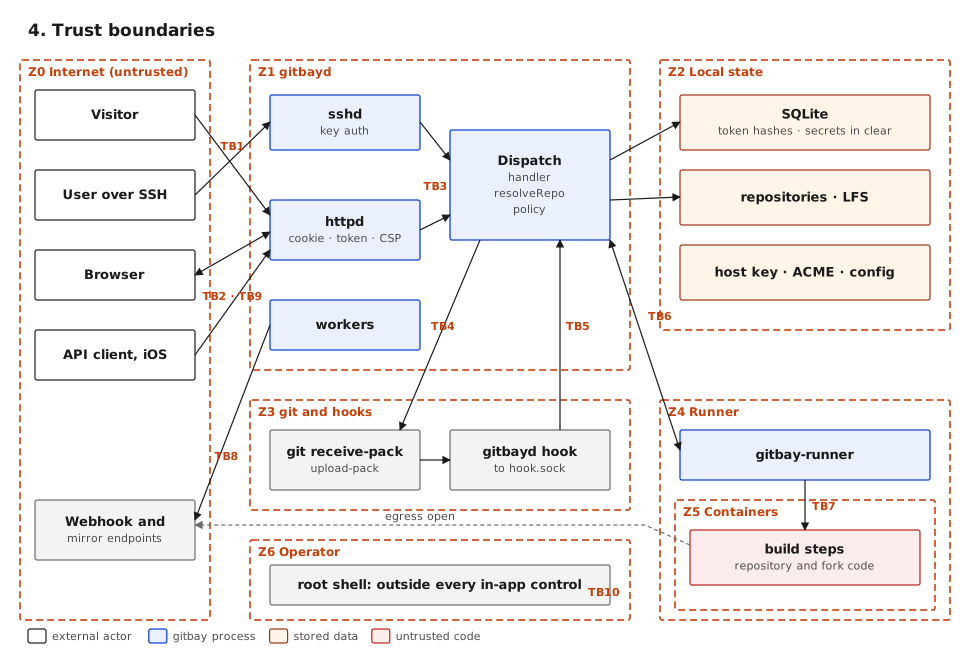
Zones
| Zone | Contents | Trust |
|---|---|---|
| Z0 | The internet: visitors, clients, webhook and mirror endpoints | none |
| Z1 | gitbayd process | holds all policy; trusted |
| Z2 | Local state: SQLite, repositories, LFS, keys, config | trusted; readable by the gitbay user |
| Z3 | git subprocesses and hook processes | run as gitbay on data from Z0; their decisions come from Z1 |
| Z4 | CI runner service | trusted to report honestly; holds secrets for trusted builds |
| Z5 | CI containers | untrusted code from repositories and forks |
| Z6 | Operator host access | root; outside every in-application control |
Boundaries
| ID | Boundary | What crosses | Control at the boundary |
|---|---|---|---|
| TB1 | Z0 → Z1 SSH | key auth, exec requests, git packs | public-key auth, per-IP failure limit (internal/sshd/sshd.go, ratelimit.go); unknown keys reach only register |
| TB2 | Z0 → Z1 HTTPS | page requests, form posts, API calls, fetches, LFS | TLS; session cookie or bearer token; checkOrigin on posts; CSP and security headers (internal/httpd/routes.go); smart HTTP is fetch-only (smart.go) |
| TB3 | identity → data | every command | Dispatch gates, then resolveRepo with policy predicates; unreadable repositories are indistinguishable from missing ones (5) |
| TB4 | Z1 → Z3 git | argv, repository path, stdin packs | argv built by code, never a shell; repository path from the database, not the request (internal/gitutil) |
| TB5 | Z3 → Z1 hook socket | ref updates, repository id, user id, key scope, push token, commit objects | the socket is mode 0600 and, on Linux, refuses a peer whose uid is not the daemon's; a request must carry the token sshd minted for its receive-pack (stored hashed in push_tokens) and name the same repository, account and scope. The daemon then decides with policy.CheckPush and sig.VerifyCommit (internal/hookd/hookd.go) |
| TB6 | Z4 ↔ Z1 runner channel | build claims (with secrets for trusted builds), logs, results | runner-scoped SSH key; claims limited to attached repositories; secrets only when the build is trusted (internal/control/build.go) |
| TB7 | Z5 → Z4 container | build steps, workspace, build home | rootless podman, operator-provisioned image, cgroup limits; a trusted build's home is its repository's, an untrusted build's is discarded with it; private ranges and the host's loopback (but DNS) closed; trusted: internet open, host public 22/80/443; untrusted: internet TCP 80/443 and DNS, no host (#260) |
| TB8 | Z1 → Z0 outbound | webhooks, mirrors, mail, push | address checks on user-supplied URLs; HMAC on webhooks; no redirects (3) |
| TB9 | user content → browser | Markdown and Org bodies, READMEs, filenames | HTML sanitised (ugcHTML, internal/httpd/web.go, bluemonday); CSP script-src 'none' |
| TB10 | Z6 → everything | host shell | operator SSH on 2222, keys only, fail2ban; append-only offsite backup credentials |
Flows
Each flow lists its hops in order. Boundary IDs refer to the table above.
A. SSH control command
- Client opens SSH;
authenticatelooks up the key fingerprint and records user id, key id and scope in the connection (internal/sshd/sshd.go). TB1. - Each exec request:
runExecreloads the account, touches the key's last-used time, callsExec(sshd.go). Exectokenizes the command line (no shell) and routes git transport verbs torunGit, everything else tocontrol.DispatchwithSourceset to the key fingerprint (sshd.go).Dispatchgates and runs the handler; mutating successes are audited (internal/control/control.go). TB3.
B. git push over SSH
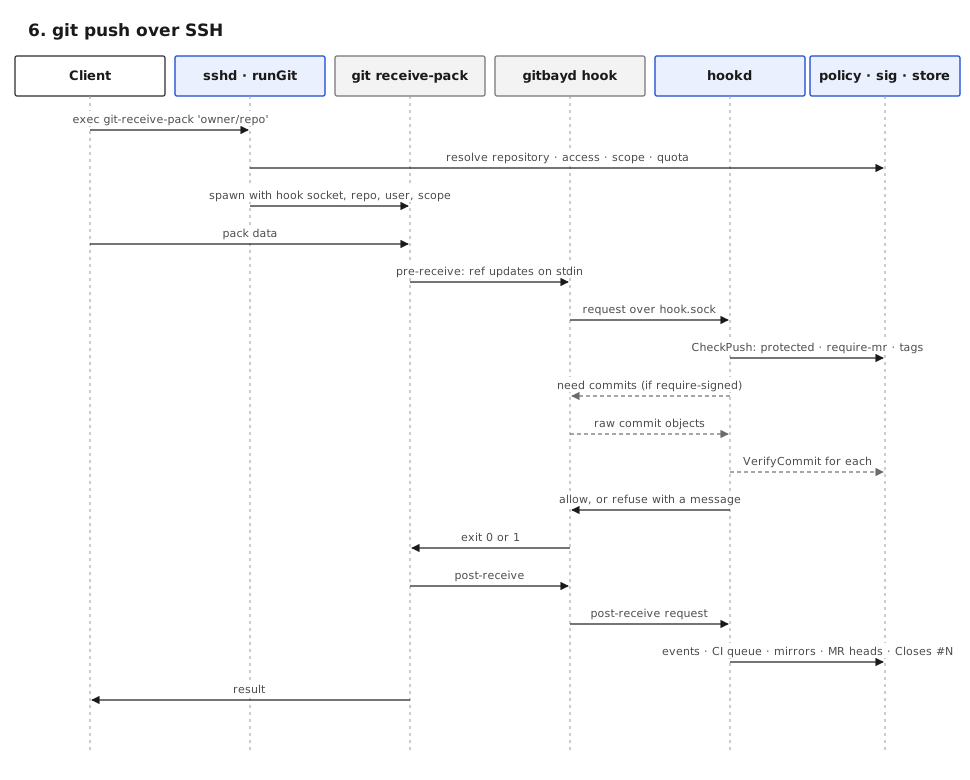
runGitresolves the repository, applies the deploy-key or account checks, archive and pull-mirror refusals and the owner's storage quota (sshd.go). TB3.git receive-packruns with the hook socket path, repository id, user id and key scope in its environment, and a push token (sshd.go). TB4.- git runs
pre-receive, which isgitbayd hook pre-receive. It reads the ref updates, computes ancestry in git's quarantine environment and asks the daemon over the socket (cmd/gitbayd/hook.go). TB5. - The daemon applies
policy.CheckPush(protected branches,require-mr, protected tags, server-ownedrefs/merge-requests/*) and, when the repository requires signed commits, asks for every incoming commit object and verifies each (internal/hookd/hookd.go). - On refusal the hook exits 1 and git rejects the push atomically.
- On success git runs
post-receive; the daemon records events, marks mirrors dirty, queues CI, syncs merge request heads, processesCloses #Nreferences and audits force pushes (hookd.go).
The server's own merge of a merge request does not pass through the
hooks: runMRMerge updates the ref with a compare-and-swap
(internal/control/mr.go) after MergeGates
(mr.go). When signed commits are required only fast-forward
merges are allowed, so the server never writes an unsigned commit
(mr.go).
C. Fetch over smart HTTP
GET info/refs and POST git-upload-pack serve public repositories
only; a private repository answers 404. git-receive-pack over HTTP
always answers a pkt-line refusal, so there is no password prompt and
no HTTP write path (internal/httpd/smart.go,
routes.go). TB2.
D. Web read and write
- The session cookie is hashed and looked up (
accounts.go). - Pages dispatch read commands into the registry with
Source=weband decode the JSON result into the template (internal/httpd/control.go). - Form posts pass
checkOrigin(accounts.go), dispatch the matching command, and map the exit code to a redirect or an error on the page. The pin, watch and mark-read toggles dispatchrepo pin,repo watch=/=mute=/=unwatchandnotifications readthe same way.
E. JSON API
apiAuthhashes the bearer token and looks it up; any failure is a uniform 401 (internal/httpd/api.go).- Per-account rate limit, with writes at a tenth of the read budget.
POST /api/v1/cmddispatches any command except git transport;GET /api/v1/readrefuses anything not markedReadOnly, so a GET cannot write (apiread.go).- Exit codes map to HTTP status: 0→200, 2→400, 3→404, 4→403, else 500.
F. LFS
git-lfs-authenticate over SSH applies the same repository checks as
git transport and returns a one-hour HMAC token scoped to repository,
operation and the SSH key that asked for it, deploy keys included
(internal/sshd/lfs.go, internal/lfs/lfs.go). The HTTP batch, upload
and download endpoints verify that token and that its key is still
registered, unexpired and on an enabled account (store.LiveSSHKeys),
and repeat the repository check for the key on each request; public
repositories allow anonymous download. Objects are verified against
their SHA-256 id on upload.
G. Browser login by emailed link
/logintakes a username or email; per-IP and per-account limits (5 per hour) apply, and every non-eligible case returns the same response (internal/control/loginlink.go).- A 32-byte token is mailed; only its hash is stored, valid 15 minutes.
/login?token=consumes it atomically, rechecks the account and sets the session cookie (accounts.go).
ssh git@host web login mints the same kind of link, valid 5 minutes,
to an already-authenticated key (internal/control/web.go).